
Customizable Home Lifts in Chennai: Choosing Cabin Design, Finish & Capacity

A home lift is more than a convenient way to move between floors. In a modern home, it can become an important part of the property’s architecture, interior design, and accessibility. As homeowners increasingly look for residential mobility solutions that match their specific requirements, customization has become an important consideration when selecting a home lift.

From cabin size and capacity to materials, finishes, lighting, and overall appearance, homeowners can explore different options to create a lift that works with their home rather than simply fitting a standard product into the available space.

For families considering home elevators in Chennai, understanding these customization options can make the selection process easier and help them choose a solution suited to their property and lifestyle.

Why Customization Matters in a Home Lift

Every home is different.

A compact independent house may have limited installation space, while a large villa may allow for a more spacious cabin and a more elaborate design. Similarly, a family with elderly members may have different accessibility requirements from a family primarily looking for convenient movement between floors.

This makes a one-size-fits-all approach less suitable for many residential applications.

A customizable home lift allows important elements to be considered according to the property, including cabin dimensions, capacity, entrance configuration, interior finishes, and design preferences.

Instead of treating the lift as a separate installation, homeowners can plan it as an integrated part of the home.

Choosing the Right Cabin Capacity

Capacity is one of the first things homeowners should evaluate.

The right capacity depends on more than simply counting the number of people in the household. Consider how the lift will actually be used on a daily basis.

For example, homeowners may want to accommodate:

  • Multiple family members travelling together
  • Elderly family members
  • People with mobility requirements
  • Shopping bags and groceries
  • Luggage and household items

A larger cabin can provide additional comfort, but it also requires appropriate installation space. The objective is to find a practical balance between cabin size, capacity, available space, and the home’s structural requirements.

A professional site assessment can help determine the appropriate configuration.

Cabin Design That Complements Your Home

The cabin is one of the most visible elements of a residential lift.

Rather than treating it purely as a functional enclosure, homeowners can consider how its appearance will work with the interiors of the property.

A contemporary home may benefit from a clean, minimalist cabin design. A premium villa may call for more sophisticated finishes and detailing. Glass elements can create an open visual effect, while metal finishes and carefully selected panels can provide a modern appearance.

The design should ultimately reflect the character of the property while remaining practical for everyday use.

Selecting the Right Finish

Cabin finishes can significantly influence the overall appearance of a home lift.

Stainless steel finishes can provide a sleek and contemporary look. Glass can create a sense of openness and allow the cabin to blend more naturally with certain architectural styles. Different wall panels, flooring materials, ceiling designs, and lighting options can further personalize the cabin.

However, appearance should not be the only consideration.

Since a residential lift is used regularly, homeowners should also consider durability, cleaning, maintenance, and how the chosen materials will perform over time.

The best finish is one that combines visual appeal with everyday practicality.

Considering Installation Space

Customization should begin with the property itself.

The available installation area can influence cabin dimensions, entrance configuration, and the overall design of the lift. This is particularly important when installing a lift in an existing home, where structural and space limitations may already be present.

For a new home, lift requirements can potentially be considered during the architectural planning stage. This can provide greater flexibility in determining the location and configuration.

For existing properties, a detailed site assessment is essential before finalizing the lift design.

Planning for Long-Term Accessibility

A home lift can provide benefits that extend well beyond everyday convenience.

For families with elderly parents or members with mobility challenges, a lift can make different levels of the home easier to access. It can also provide greater convenience when carrying heavy items between floors.

Homeowners should therefore think about both current and future requirements when selecting cabin capacity and configuration.

A solution that works comfortably today should ideally remain practical as the family’s needs evolve.

Made-to-Order Home Lifts for Individual Requirements

Customization is not simply about choosing different colours or cabin finishes.

A truly personalized approach considers the complete residential application — from available space and capacity to cabin design, accessibility, functionality, and aesthetics.

At SmartG Lifts, the focus is on providing customizable home lift solutions rather than approaching every residential project with a single standard configuration.

This made-to-order approach allows homeowners to discuss their specific requirements and explore a suitable combination of cabin design, finish, capacity, and functionality.

The goal is to create a lift that works with the home instead of making the homeowner compromise unnecessarily.

How to Choose the Right Configuration

Before finalizing a home lift, homeowners can consider the following questions:

How many people will regularly use the lift?

This helps determine the appropriate capacity and cabin size.

What is the available installation space?

The property’s layout and structural conditions can influence the possible configuration.

What style suits the home?

Consider the existing interiors, architecture, materials, and overall design theme.

What will the lift be used for?

Think beyond passenger movement. Groceries, luggage, mobility equipment, and household items may also need to be accommodated.

What are the long-term requirements?

A home lift should remain practical as the family’s needs change over time.

For homeowners evaluating home elevators in Chennai, considering these factors before selecting a configuration can help create a more comfortable and integrated solution.

A Home Lift Designed Around Your Home

A residential lift should be functional, comfortable, safe, and visually compatible with the property.

Customization provides homeowners with the flexibility to consider all these aspects together rather than choosing a standard configuration based solely on availability.

Whether it is the cabin capacity, interior finish, lighting, materials, or overall design, each decision can contribute to how effectively the lift fits into the home.

At SmartG Lifts, our approach is centered on creating residential lift solutions around individual requirements. From initial site considerations to cabin design and configuration, customization can help homeowners create a lift that feels like a natural part of their property.

If you are planning a new home or looking to improve accessibility in an existing multi-storey property, exploring a customized solution can be the first step toward making everyday movement easier and more convenient.

Frequently Asked Questions

1. Can I customize the cabin design of a home lift?

Yes. Depending on the selected configuration, homeowners can explore options for cabin panels, flooring, lighting, doors, glass elements, and other interior finishes.

2. How do I choose the right capacity for a residential lift?

Consider the number of regular users, available cabin space, mobility requirements, and whether the lift will also be used for carrying luggage, groceries, or other household items. A professional site assessment can help determine a suitable capacity.

3. Can SmartG customize a home lift for an existing property?

The feasibility depends on the property’s structure, available installation space, and other technical requirements. SmartG can assess the property and help determine a suitable configuration based on the specific requirements.

Choose a Home Lift That Fits Your Requirements

Every home has different needs. With a made-to-order approach, you can consider cabin design, finish, capacity, and functionality together to create a residential lift suited to your property.

Explore customized home lift solutions from SmartG Lifts and plan your home elevator in Chennai.
Read More


home lifts chennai
home lifts chennai


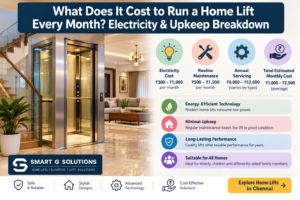
Installing a home lift is becoming a practical choice for homeowners who want easier access between floors, improved convenience, and better long-term accessibility. But while considering installation, one question often comes up: what does it actually cost to run a home lift every month?

The overall running cost is not limited to electricity. Homeowners should also consider regular maintenance, annual servicing, spare parts, and occasional repairs. Understanding these expenses beforehand makes it easier to plan a realistic budget.

For people researching home lifts chennai, the important point is to look at the total cost of ownership rather than focusing only on the initial installation price.

How Much Electricity Does a Home Lift Use? ⚡

A home lift does not consume electricity continuously like an air conditioner or refrigerator. Power is mainly required when the lift is moving, while some models may use a small amount of standby electricity for controls, lighting, displays, and safety systems.

The actual electricity consumption depends on several factors:

  • Number of trips per day
  • Number of floors
  • Lift capacity
  • Motor technology
  • Travel distance
  • Standby power consumption
  • Local electricity tariff

A small residential lift used by a family a few times each day may have a relatively manageable electricity expense. However, a larger household with frequent trips between multiple floors will naturally consume more power.

Therefore, homeowners should ask the manufacturer for an estimated monthly electricity consumption based on their expected usage instead of relying on a general figure.

What About Home Lift Maintenance? 🔧

Electricity is only one part of the running cost. Regular maintenance is equally important.

A home lift contains electrical, mechanical, safety, and control components. Periodic inspection helps identify issues before they become major problems.

Maintenance may include checking:

  • Lift doors and door sensors
  • Motor and drive system
  • Control panel
  • Safety mechanisms
  • Cables or other lifting components
  • Cabin operation
  • Emergency systems
  • Electrical connections

The cost depends on the lift model, service agreement, technology, and maintenance provider.

Some manufacturers offer annual maintenance contracts, while others provide different service packages depending on the requirements of the homeowner.

When comparing home lifts in Chennai, it is therefore useful to ask for both the installation quotation and the expected annual maintenance cost.

Annual Servicing and Repairs 📅

Even when a lift is properly maintained, some components may eventually require replacement.

Wear and tear can affect parts such as door components, sensors, switches, electrical components, and other mechanical systems. The replacement cost depends on the specific component and lift design.

This is why homeowners should not calculate their budget based only on monthly electricity consumption.

A better approach is to create an annual ownership budget that includes:

Electricity + routine maintenance + annual servicing + potential repairs

For example, if annual maintenance costs ₹6,000, the maintenance component alone averages ₹500 per month when spread across the year. Electricity would then be added according to actual household usage.

These are planning examples rather than fixed industry prices because every installation is different.

Does Frequent Usage Increase the Running Cost? 🏠

Yes. More frequent usage can increase electricity consumption and the number of operating cycles for components such as doors and mechanical systems.

However, homeowners should not avoid using their lift simply to reduce electricity expenses. A residential lift is installed to provide convenience and accessibility.

The better strategy is to select a lift that matches the household’s actual requirements.

For example, a four-member family living in a two- or three-storey home may have different requirements from a large family using the lift throughout the day.

Correct sizing can help avoid unnecessary capacity and ensure that the system is suitable for the intended application.

How Can You Reduce Home Lift Running Costs? 💡

There are several practical ways to keep long-term expenses under control.

1. Select the Right Lift Capacity

Choose a lift according to the number of users and expected load. Overspecifying a system may increase the initial investment without providing a meaningful benefit.

2. Compare Energy Consumption

Ask suppliers for estimated electricity consumption and standby power requirements. Different technologies can have different operating characteristics.

3. Follow the Maintenance Schedule

Skipping routine maintenance may save money temporarily but can increase the risk of unexpected breakdowns and expensive repairs.

4. Check the Warranty

Understand exactly what is covered under the manufacturer’s warranty and for how long.

5. Compare Annual Maintenance Contracts

Before purchasing, ask whether preventive maintenance, labour, emergency visits, and spare parts are included in the service package.

6. Use a Reliable Service Provider

Good after-sales support can make a significant difference to the long-term ownership experience.

What Should You Ask Before Buying a Home Lift? 🤔

Before making a purchase, homeowners should request clear answers to the following questions:

  • What is the estimated electricity consumption?
  • How much does annual maintenance cost?
  • What does the warranty cover?
  • How often should the lift be serviced?
  • What happens during a power failure?
  • What safety systems are included?
  • Are emergency service visits available?
  • How much do commonly replaced spare parts cost?
  • What civil or structural work is required?
  • What is the expected service life of the system?

Getting these details in writing makes it easier to compare different options objectively.

Is a Home Lift Expensive to Run? 💰

A home lift should not be evaluated based solely on its electricity bill. For most homeowners, the complete running cost consists of several smaller expenses spread across the year.

Electricity consumption depends heavily on usage, while maintenance and servicing depend on the equipment and service agreement.

For homeowners exploring home lifts in Chennai, comparing the complete lifecycle cost can provide a much clearer picture than comparing installation prices alone.

A reliable residential lift should combine appropriate capacity, safety features, efficient operation, regular maintenance, and dependable after-sales support.

Final Thoughts

The monthly cost of operating a home lift depends on the specific installation and how frequently it is used. Electricity is one component, but maintenance, servicing, repairs, and replacement parts should also be included when calculating the long-term budget.

The smartest approach is to ask the lift provider for a complete cost estimate covering installation, electricity expectations, maintenance, warranty, servicing, and potential replacement costs.

If you are planning a residential lift installation, Smart G Solutions can be explored for home lift solutions and professional guidance based on your home’s requirements.

Choose the right system, maintain it regularly, and consider the total ownership cost—not just the purchase price—when planning your home lift in Chennai.

Frequently Asked Questions

1. How much electricity does a home lift consume every month?

Electricity consumption varies depending on the lift model, motor, number of floors, travel distance, standby consumption, and frequency of use. The manufacturer can provide an estimated consumption based on your expected usage.

2. How often does a home lift need maintenance?

The recommended maintenance schedule depends on the lift model and manufacturer. Regular inspections and servicing help maintain safe and reliable operation.

3. What is the biggest ongoing expense of a home lift?

There is no single fixed expense. Electricity, routine maintenance, annual servicing, and occasional component replacement can all contribute to the total ownership cost.

Read More

7 Myths About Home Lifts in Chennai — Busted

Home lifts are becoming an increasingly practical choice for modern multi-storey homes. Yet, many homeowners still hesitate because of common misconceptions about cost, space, safety, installation, and maintenance.

Some of these concerns come from experiences with traditional commercial elevators, while others are simply outdated assumptions.

If you are considering lifts in Chennai for your home, it is worth separating the myths from the facts before making a decision.

Here are seven common misconceptions—and what homeowners should actually know.

Myth 1: Home Lifts Are Only for Luxury Homes

A home lift may look like a premium addition, but its purpose goes beyond luxury.

For families with elderly parents, people with mobility concerns, or households living across multiple floors, a residential lift can provide everyday convenience and easier access.

It can also be useful for carrying groceries, luggage and other heavy items between floors.

The reality: A home lift can be a practical accessibility and convenience solution, not simply a luxury feature.


Myth 2: A Home Lift Needs a Huge Amount of Space

This is one of the most common concerns.

Many homeowners assume that installing a lift requires a large area comparable to a commercial elevator. In reality, residential lift systems are available in different configurations and sizes.

The space required depends on several factors, including:

  • Lift type
  • Cabin capacity
  • Number of floors
  • Available floor area
  • Structural conditions
  • Entry and exit configuration

Some residential solutions can be considered for homes where space is limited.

However, there is no universal solution for every property. A proper site assessment is the best way to determine what is feasible.


Myth 3: Installing a Home Lift Means Major Demolition

Not necessarily.

The amount of civil work depends on the building and the lift system selected. Existing homes may have different installation requirements from new constructions.

Depending on the design, installation could involve provisions for a shaft, landing areas, electrical connections, structural support, or other modifications.

The important thing is to understand the requirements before selecting a model.

A professional assessment can help homeowners understand:

What needs to be modified → Where the lift can be installed → How much space is required → What preparation is necessary

This makes the installation process more predictable.


Myth 4: Home Lifts Are Unsafe During Power Cuts

Power interruptions are a valid concern, particularly when a lift is being considered for elderly family members.

However, modern residential lift systems can incorporate emergency safety features depending on the model and configuration. These may include backup power arrangements, emergency lighting, alarms, communication systems, and controlled emergency operation.

The important point is not to assume that every lift has identical features.

Before purchasing, ask the supplier:

“What happens if there is a power failure while someone is using the lift?”

Understanding the emergency procedure and available safety features should be an essential part of the buying decision.


Myth 5: A Home Lift Will Dramatically Increase My Electricity Bill

A lift does consume electricity, but the actual operating cost depends on factors such as the technology, motor or drive system, capacity, travel distance, and frequency of use.

A residential lift also typically has a very different usage pattern from a commercial elevator operating continuously throughout the day.

Instead of focusing only on the initial purchase price, homeowners should consider the overall cost of ownership.

This includes:

  • Power consumption
  • Maintenance
  • Spare parts
  • Warranty
  • Service requirements

When comparing lifts in Chennai, asking about power requirements and long-term operating costs can give you a much clearer picture.


Myth 6: Home Lifts Don’t Need Maintenance

This one is definitely a myth.

A home lift contains mechanical and electrical components that require periodic inspection and maintenance. Regular servicing helps keep the equipment operating reliably and allows potential issues to be identified earlier.

Before choosing a lift, ask about the available maintenance support.

Important questions include:

  • Is an Annual Maintenance Contract available?
  • What does the warranty cover?
  • How quickly is service provided?
  • Are replacement parts readily available?
  • What preventive maintenance is recommended?

A good installation is important, but dependable after-sales support is equally valuable over the life of the lift.


Myth 7: All Home Lifts Are the Same

Perhaps the biggest mistake is assuming that every residential lift offers the same specifications.

Different systems can vary in:

  • Technology
  • Passenger capacity
  • Cabin dimensions
  • Installation requirements
  • Power consumption
  • Safety features
  • Interior finishes
  • Maintenance requirements

This is why choosing a lift based solely on the lowest quotation can be misleading.

The right choice should balance safety, functionality, space, design, reliability, installation requirements, and long-term support.


So, Are Home Lifts Worth Considering?

For the right property and requirements, a residential lift can be a valuable addition.

It can make a multi-storey home more accessible, convenient, and comfortable while also making the property better suited to changing family needs over time.

The best approach is not to decide based on assumptions.

Instead:

Assess your space.
Understand your requirements.
Compare suitable technologies.
Check safety features.
Understand maintenance and service.
Then make your decision.

At SmartG Lifts, the focus is on helping homeowners understand residential lift options and select solutions suited to their property’s requirements.

Frequently Asked Questions

1. Can a home lift be installed in an existing house?

In many cases, yes. The feasibility depends on the property’s layout, available space, structural conditions, and the type of lift selected. A professional site assessment should be carried out before installation.

2. Are home lifts suitable for elderly family members?

Yes. A residential lift can make movement between floors easier and reduce dependence on stairs. Safety features, ease of operation, and reliable maintenance should be considered when selecting a system.

3. What should I consider before choosing a home lift?

Look at space requirements, capacity, lift technology, safety features, power requirements, installation work, warranty, maintenance, service support, and overall ownership cost.

Make the Right Choice for Your Home

Don’t let common myths prevent you from exploring a solution that could make your home more comfortable and accessible.

If you’re planning a residential lift installation, speak with SmartG Lifts to understand the options available in Chennai.

Read More
