

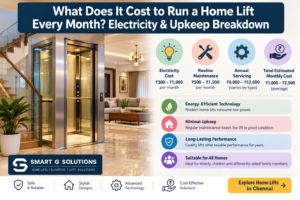
Installing a home lift is becoming a practical choice for homeowners who want easier access between floors, improved convenience, and better long-term accessibility. But while considering installation, one question often comes up: what does it actually cost to run a home lift every month?
The overall running cost is not limited to electricity. Homeowners should also consider regular maintenance, annual servicing, spare parts, and occasional repairs. Understanding these expenses beforehand makes it easier to plan a realistic budget.
For people researching home lifts chennai, the important point is to look at the total cost of ownership rather than focusing only on the initial installation price.
How Much Electricity Does a Home Lift Use? ⚡
A home lift does not consume electricity continuously like an air conditioner or refrigerator. Power is mainly required when the lift is moving, while some models may use a small amount of standby electricity for controls, lighting, displays, and safety systems.
The actual electricity consumption depends on several factors:
- Number of trips per day
- Number of floors
- Lift capacity
- Motor technology
- Travel distance
- Standby power consumption
- Local electricity tariff
A small residential lift used by a family a few times each day may have a relatively manageable electricity expense. However, a larger household with frequent trips between multiple floors will naturally consume more power.
Therefore, homeowners should ask the manufacturer for an estimated monthly electricity consumption based on their expected usage instead of relying on a general figure.
What About Home Lift Maintenance? 🔧
Electricity is only one part of the running cost. Regular maintenance is equally important.
A home lift contains electrical, mechanical, safety, and control components. Periodic inspection helps identify issues before they become major problems.
Maintenance may include checking:
- Lift doors and door sensors
- Motor and drive system
- Control panel
- Safety mechanisms
- Cables or other lifting components
- Cabin operation
- Emergency systems
- Electrical connections
The cost depends on the lift model, service agreement, technology, and maintenance provider.
Some manufacturers offer annual maintenance contracts, while others provide different service packages depending on the requirements of the homeowner.
When comparing home lifts in Chennai, it is therefore useful to ask for both the installation quotation and the expected annual maintenance cost.
Annual Servicing and Repairs 📅
Even when a lift is properly maintained, some components may eventually require replacement.
Wear and tear can affect parts such as door components, sensors, switches, electrical components, and other mechanical systems. The replacement cost depends on the specific component and lift design.
This is why homeowners should not calculate their budget based only on monthly electricity consumption.
A better approach is to create an annual ownership budget that includes:
Electricity + routine maintenance + annual servicing + potential repairs
For example, if annual maintenance costs ₹6,000, the maintenance component alone averages ₹500 per month when spread across the year. Electricity would then be added according to actual household usage.
These are planning examples rather than fixed industry prices because every installation is different.
Does Frequent Usage Increase the Running Cost? 🏠
Yes. More frequent usage can increase electricity consumption and the number of operating cycles for components such as doors and mechanical systems.
However, homeowners should not avoid using their lift simply to reduce electricity expenses. A residential lift is installed to provide convenience and accessibility.
The better strategy is to select a lift that matches the household’s actual requirements.
For example, a four-member family living in a two- or three-storey home may have different requirements from a large family using the lift throughout the day.
Correct sizing can help avoid unnecessary capacity and ensure that the system is suitable for the intended application.
How Can You Reduce Home Lift Running Costs? 💡
There are several practical ways to keep long-term expenses under control.
1. Select the Right Lift Capacity
Choose a lift according to the number of users and expected load. Overspecifying a system may increase the initial investment without providing a meaningful benefit.
2. Compare Energy Consumption
Ask suppliers for estimated electricity consumption and standby power requirements. Different technologies can have different operating characteristics.
3. Follow the Maintenance Schedule
Skipping routine maintenance may save money temporarily but can increase the risk of unexpected breakdowns and expensive repairs.
4. Check the Warranty
Understand exactly what is covered under the manufacturer’s warranty and for how long.
5. Compare Annual Maintenance Contracts
Before purchasing, ask whether preventive maintenance, labour, emergency visits, and spare parts are included in the service package.
6. Use a Reliable Service Provider
Good after-sales support can make a significant difference to the long-term ownership experience.
What Should You Ask Before Buying a Home Lift? 🤔
Before making a purchase, homeowners should request clear answers to the following questions:
- What is the estimated electricity consumption?
- How much does annual maintenance cost?
- What does the warranty cover?
- How often should the lift be serviced?
- What happens during a power failure?
- What safety systems are included?
- Are emergency service visits available?
- How much do commonly replaced spare parts cost?
- What civil or structural work is required?
- What is the expected service life of the system?
Getting these details in writing makes it easier to compare different options objectively.
Is a Home Lift Expensive to Run? 💰
A home lift should not be evaluated based solely on its electricity bill. For most homeowners, the complete running cost consists of several smaller expenses spread across the year.
Electricity consumption depends heavily on usage, while maintenance and servicing depend on the equipment and service agreement.
For homeowners exploring home lifts in Chennai, comparing the complete lifecycle cost can provide a much clearer picture than comparing installation prices alone.
A reliable residential lift should combine appropriate capacity, safety features, efficient operation, regular maintenance, and dependable after-sales support.
Final Thoughts
The monthly cost of operating a home lift depends on the specific installation and how frequently it is used. Electricity is one component, but maintenance, servicing, repairs, and replacement parts should also be included when calculating the long-term budget.
The smartest approach is to ask the lift provider for a complete cost estimate covering installation, electricity expectations, maintenance, warranty, servicing, and potential replacement costs.
If you are planning a residential lift installation, Smart G Solutions can be explored for home lift solutions and professional guidance based on your home’s requirements.
Choose the right system, maintain it regularly, and consider the total ownership cost—not just the purchase price—when planning your home lift in Chennai.
Frequently Asked Questions
1. How much electricity does a home lift consume every month?
Electricity consumption varies depending on the lift model, motor, number of floors, travel distance, standby consumption, and frequency of use. The manufacturer can provide an estimated consumption based on your expected usage.
2. How often does a home lift need maintenance?
The recommended maintenance schedule depends on the lift model and manufacturer. Regular inspections and servicing help maintain safe and reliable operation.
3. What is the biggest ongoing expense of a home lift?
There is no single fixed expense. Electricity, routine maintenance, annual servicing, and occasional component replacement can all contribute to the total ownership cost.
